


Ibiza is one of the most beautiful islands in Spain. It is part of the Balearic Islands, in the Mediterranean Sea. Beyond its fiestas, coves, beaches and diversity of fauna and flora, this island has experienced, year after year, an increase in the number of people living there.
People have gone from wondering what to do in Ibiza to where to live in Ibiza. Behind every point of the island, its population is growing and, little by little, Ibiza has become a destination for second homes, both for nationals and foreigners. Everyone falls in love with it.
Current population statistics of Ibiza
The Balearic Islands is one of the autonomous communities that has grown the most in recent years. Its climate, its gastronomy and its people have made more than 300,000 people decide to start a new life on one of its islands, with Ibiza being the second fastest growing island in the last decade.
Latest population figures
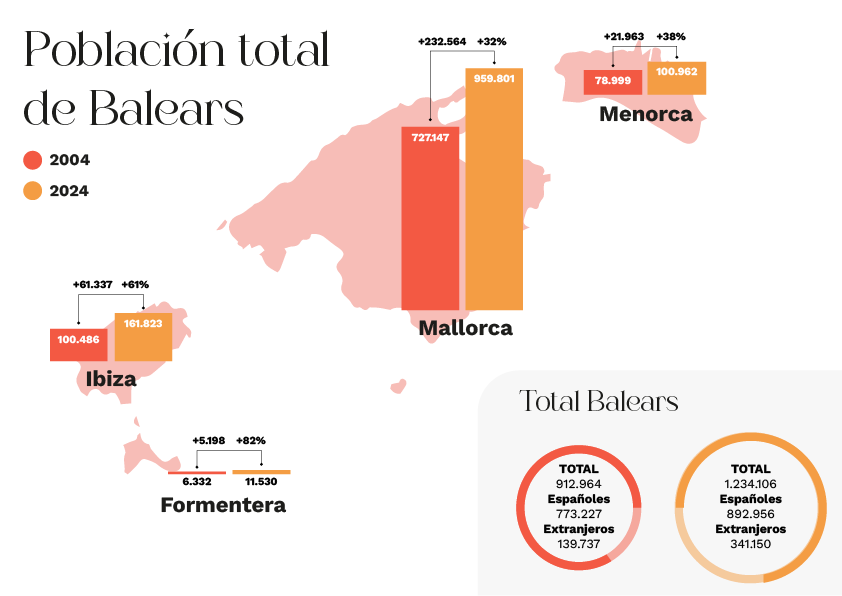
According to the latest data from the National Statistics Institute (INE), Ibiza had barely 100,000 inhabitants in 2004. Ten years later, things have taken a 180-degree turn and the population has increased by 61%, compared to Menorca’s 28%.
Ibiza now has 161,823 inhabitants, both international and national.
Comparison with previous years
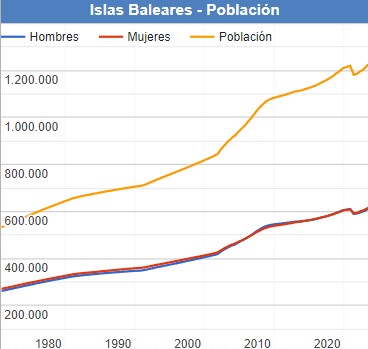
Compared to previous years, Ibiza’s population has shown a steady growth. In 2010, the population was around 133,000, which represents an increase of almost 20% in just over a decade.
But why has Ibiza grown so much?
- Tourism boom
- Improving infrastructure and services
- New international residents
Population density
With an area of approximately 572 square kilometres, the density is estimated at around 280 inhabitants per square kilometre. This can vary significantly between urban areas, such as Ibiza town, and quieter rural areas.
Demographic breakdown of Ibiza Island
But what is the profile of the people who live in Ibiza? How old are they? Are there more men or women? What nationalities live on the island?
Age Distribution
The population of Ibiza is characterised by its youth. The majority of the population is in the 30-50 age range, followed by the 20-30 age group. This is partly due to the island’s attraction to young people seeking employment in the tourist industry or wishing to enjoy its relaxed lifestyle.
Gender Distribution
| Year | Men | Women |
|---|---|---|
| 2023 | 26.114 | 25.882 |
| 2022 | 25.550 | 25.165 |
| 2021 | 25.538 | 25.105 |
| 2020 | 25.766 | 25.362 |
| 2019 | 25.031 | 24.752 |
| 2018 | 24.984 | 24.743 |
| 2017 | 25.008 | 24.681 |
| 2016 | 24.996 | 24.553 |
| 2015 | 25.264 | 24.711 |
| 2014 | 25.233 | 24.460 |
| 2013 | 25.692 | 24.709 |
| 2012 | 25.523 | 24.245 |
| 2011 | 25.340 | 24.048 |
| 2010 | 25.479 | 24.037 |
| 2009 | 25.131 | 23.553 |
| 2008 | 24.217 | 22.618 |
| 2007 | 22.585 | 21.529 |
| 2006 | 21.851 | 21.033 |
| 2005 | 21.838 | 20.959 |
| 2004 | 20.823 | 20.168 |
| 2003 | 20.386 | 19.789 |
| 2002 | 18.959 | 18.449 |
| 2001 | 17.483 | 17.296 |
| 2000 | 16.592 | 16.631 |
| 1999 | 16.319 | 16.379 |
| 1998 | 15.728 | 15.854 |
| 1996 | 14.598 | 14.851 |
| 1995 | 17.470 | 17.140 |
| 1994 | 17.315 | 17.021 |
| 1993 | 17.280 | 17.000 |
| 1992 | 15.973 | 15.988 |
| 1991 | 14.898 | 15.037 |
| 1990 | 17.177 | 16.599 |
| 1989 | 16.452 | 15.862 |
| 1988 | 15.251 | 14.799 |
| 1987 | 14.024 | 13.661 |
| 1986 | 13.862 | 13.522 |
Nationalities
According to the data provided by the INE in the Padrón statistics, the number of foreign-born residents on Eivissa is 16,357.
Of these, 8,694 people were born in America, with 4,110 men and 4,584 women. As for those born in Africa, there are 1,988 inhabitants, with 1,278 males and 710 females. Asia contributes 887 residents, of which 426 are men and 461 are women. Finally, Oceania has 25 inhabitants, including 10 men and 15 women.
Some of the countries of origin of those now living in Ibiza are:
- Italy
- Argentina
- Paraguay
- Argentina
- Romania
- Morocco
- France
Population trends and growth
As we have already seen, the Ibiza’s demographic trends are booming. The construction of new infrastructures, such as marinas and luxury residential developments, has attracted investors and new residents, which has contributed to the increase in population.
Impact of tourism season on population
The tourist season has a significant impact on the population of Ibiza. During the summer months, the
If you are thinking of living in Ibiza, don’t hesitate and make this island your home!
